Thoughts on Hiring, part 2
Reflections on hiring based on my experience building the product design team at Jiva
There are lot of opinions out there about hiring. Part 1 was written in 2020-21, when I was on interview panels for product design and product management. Whereas Part 2 consists of my reflections after being in the role of the hiring manager and co-designing Jiva’s hiring process.
1. Your hiring process is a reflection of your culture
The design hiring process isn’t standardised. These days you’ll see a variety of rounds; visual portfolios, take-home assignments, whiteboarding sessions, etc. The mix you choose isn’t random; it’s a reflection of your organization’s culture. You’re designing a candidate’s very first experience of how your team thinks and works.
Different rounds signal different things. Asking for visual designs in a portfolio implies that your product team drives the flows and you need someone with strong visual craft. Take-home assignments (and their subsequent presentation) reveal the candidate’s communication skills, which can be especially useful if your team works in a traditional “siloed” setup. Collaborative whiteboarding sessions show you how it feels to partner with them day-to-day but usually your organization’s designers work solo within their own teams.
None of these are inherently wrong. But if you are not mindful about your processes you end up unnecessarily making the candidate experience time consuming, anxiety-filled, and worse, you start evaluating candidates for the wrong set of attributes — a costly mistake that almost always leads to failure down the line.
2. Today’s design team needs to be multi-faceted
When I first started taking interviews (in 2015), my evaluation criteria naturally leaned toward a certain kind of product designer — usually someone whose strengths mirrored what I personally valued. That worked when every designer owned a single product end-to-end. But as the organization grew, this approach started breaking down. Designers now had to work together, share problem spaces, and complement one another’s strengths rather than operate in isolation and we hadn’t hired for that.
A better approach — and one I wish I had learnt earlier1 — is to step back and visualise your team’s skillset as a whole. One simple way to do this is by mapping your organization’s design competencies onto a rough spider chart or competency map2 and plotting each designer against it. It doesn’t need to be perfect; the point is to create a shared view of where your team is strong, where it’s weak, and if you’re overly dependent on the skills of a single person.

This kind of visualisation becomes even more valuable when you’re managing multiple teams or products. It gives you clarity on what gaps you’re trying to fill, instead of defaulting to hiring “more of the same.” For example, pairing a highly visual designer with a more analytical one can create a healthier balance, with each designer taking control of the tasks as per their skill sets.
In other words, what you need to realise is that you are not hiring an individual — you’re shaping the distribution of strengths and weaknesses across your entire design function.
3. There is no place for ego in the team
It’s called a design team for a reason. The product the user experiences should feel seamless, not like a patchwork of different personalities, preferences, or stylistic signatures. One of the biggest gaps in a skills-only evaluation is that it completely misses the collaboration layer of design: how someone shows up, how they listen, and how they work with others under pressure.
Your spider chart or competency map can show you strengths and weaknesses in craft, but it won’t tell you whether a candidate can actually work well with the rest of your organization. That’s where cultural alignment matters. A designer who is stubborn, who refuses to take cross-functional feedback, or insists on “their way” will quickly become a bottleneck — no matter how talented they are.
Getting people who play well together is one of the most underrated aspects of building a high-performing design org. A difficult personality erodes trust, slows down execution, and adds unnecessary emotional weight on everyone else — a mess that you, as the design manager, will spend a lot of time and energy sorting out.
This is why running a “vibe check” through your existing team — designers, PMs, engineers — can be invaluable. These aren’t popularity tests; they’re ways to sense how someone collaborates in real, messy, day-to-day situations and to check how excited stakeholders are about working with the candidate.
The goal isn’t to hire the best individual — it’s to hire the person who will make the team stronger.
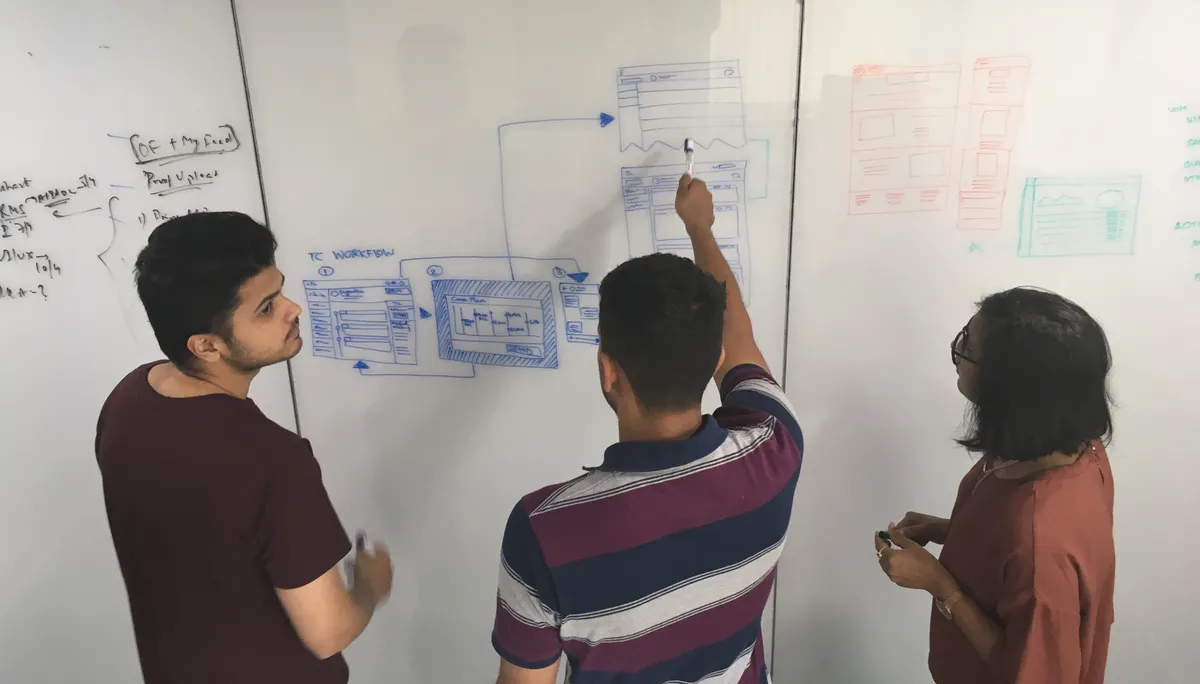
Cover image: Akshay, Hetang and Riya working on a whiteboard at Practo, 4 April 2017
